How much does a locksmith cost in 2026?
By Kiss János 14 min read
Why locksmith prices seem all over the map
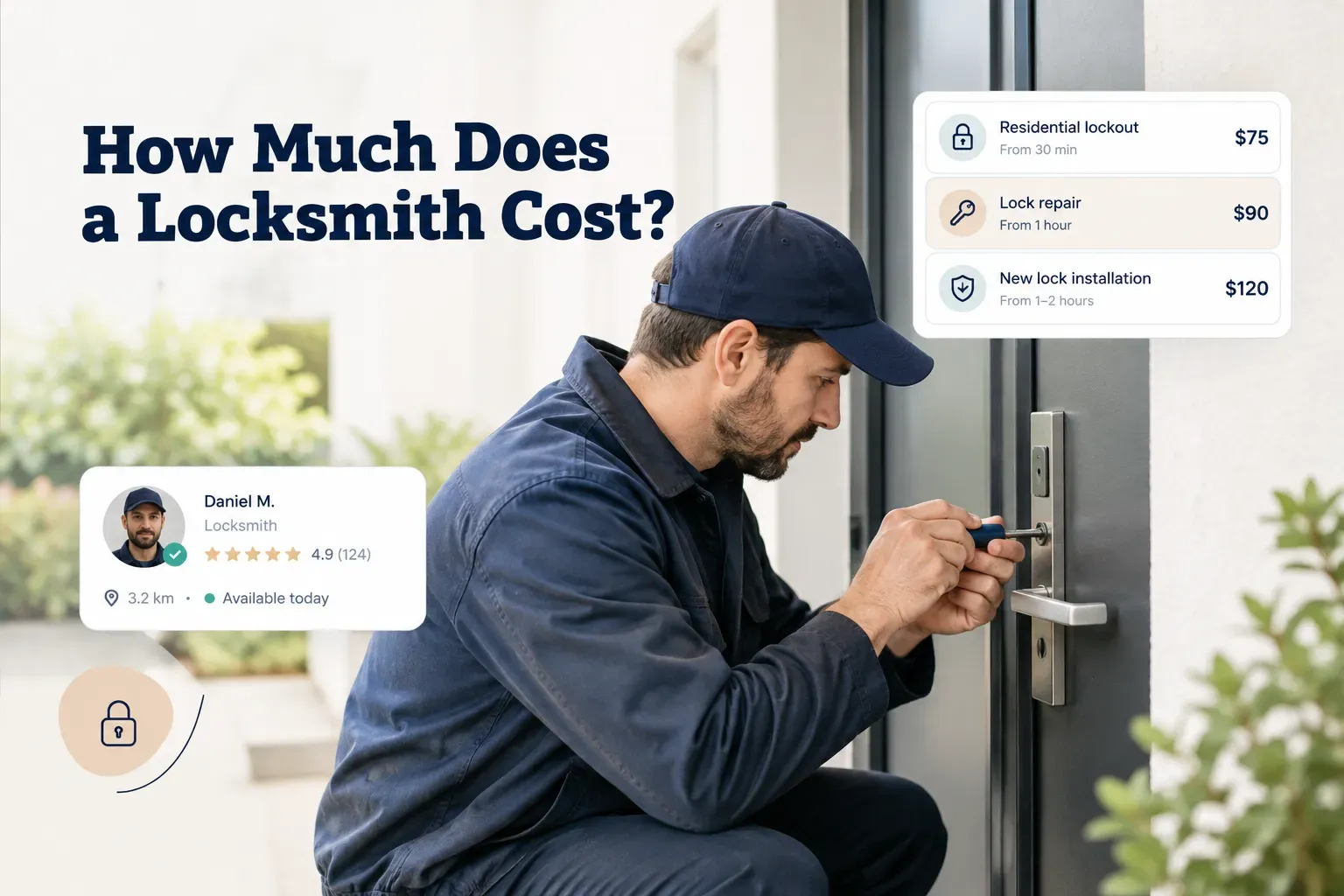
Search “how much does a locksmith cost” and you’ll see the same tidy range again and again: $75 to $200. That number isn’t wrong.
It just isn’t the whole story.
Most published figures describe the advertised service price, the headline rate a company uses to win your call. What you actually pay at the door is the out-the-door cost, and it often includes a trip charge, labor time, parts, mileage, and sometimes an after-hours surcharge stacked on top.
This guide breaks those pieces apart. You’ll see what a locksmith service call fee covers, how flat-rate and hourly billing differ, and what common jobs really cost in 2026, so you can estimate a realistic total before anyone is dispatched.
It’s written for the people who usually need a locksmith on short notice:
Homeowners locked out of the house. Renters who need a lock rekeyed after a roommate moves out. Drivers stuck with a dead transponder key. Landlords turning over units between tenants. And small-business owners securing a storefront after an employee leaves.
One more thing explains the confusion.
Pricing models vary by region and by provider, and a mobile locksmith in rural Montana runs a very different business than a shop in downtown Chicago.
That’s why two “average cost” articles can disagree by $100 or more… and both can be technically accurate.
How locksmiths actually build your bill
Two locksmiths can do the identical job and hand you invoices that look nothing alike. The difference usually isn’t honesty.
It’s billing structure.
Nearly every locksmith bill is assembled from four building blocks. Once you can spot them, you can compare quotes on equal terms instead of comparing one company’s labor-only number against another’s all-in price.
Flat rate versus hourly labor
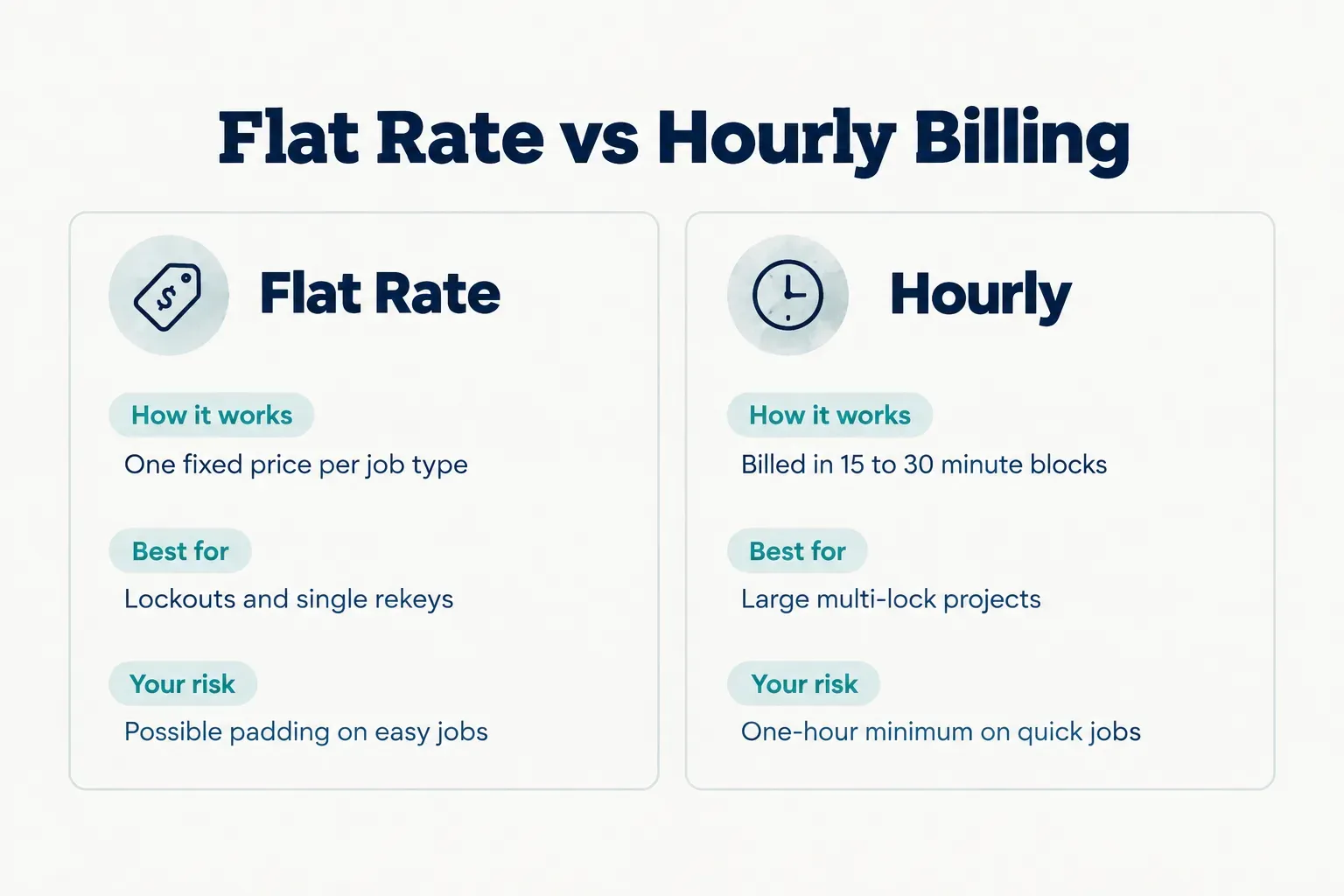
The first question to ask any locksmith is simple: do you charge by the job or by the clock? Each model has a different risk profile for you as the customer.
- Flat-rate locksmith pricing sets a fixed price for a defined job type, such as “residential lockout” or “rekey one cylinder,” agreed before work starts. You know the number upfront, and if the technician struggles with a stubborn lock, that’s their problem, not yours.
- Hourly locksmith labor bills for time on site, typically in 15 to 30 minute increments with a one-hour minimum. A quick 10-minute lockout still costs you a full hour, but a complex job like rekeying an entire office may come out cheaper than a padded flat rate.
- Hybrid billing is common too. Many companies charge a flat dispatch fee plus hourly labor plus parts, which is where totals start to drift away from the advertised figure.
- Flat rates tend to favor simple, predictable jobs (lockouts, single rekeys, deadbolt installation), while hourly billing tends to favor larger, multi-lock projects where the work scales with time.
Service-call, dispatch, and mileage fees
Before a locksmith touches your lock, the meter is often already running. Travel costs are where many surprise charges come from.
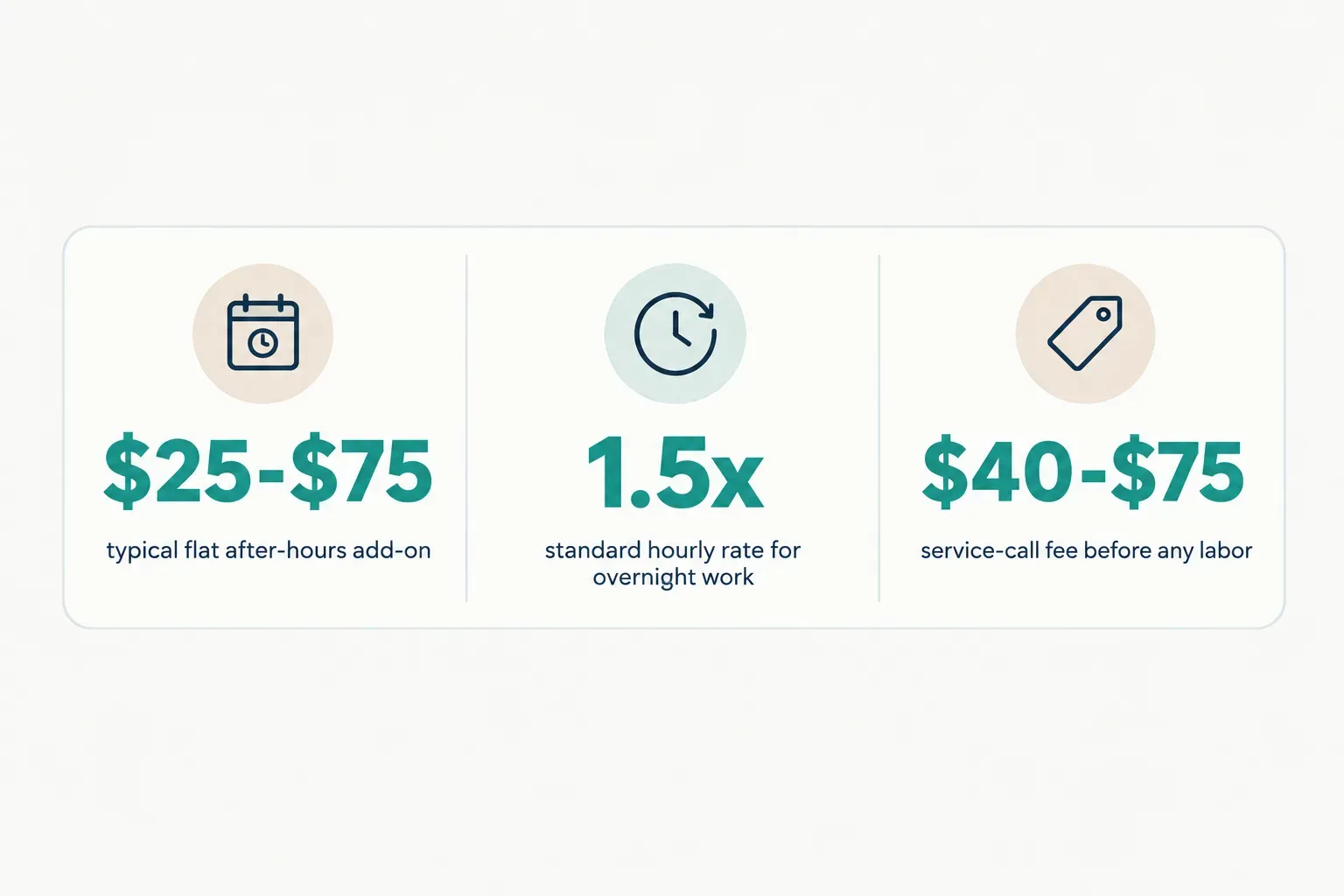
- The locksmith service call fee (also called a dispatch fee or trip charge) usually runs $40 to $75. It covers the technician’s drive, fuel, and time, and it’s separate from the labor for the actual job.
- Many companies charge the service-call fee even if you cancel after the technician is dispatched. If your roommate shows up with a spare key 10 minutes later, you may still owe $50 or more.
- A mileage fee applies when your address falls outside the provider’s standard service radius, often 15 to 25 miles. Rural customers commonly see $1 to $3 per extra mile, or a flat out-of-area surcharge.
- Parts are billed separately from labor. Cylinders, cut keys, deadbolts, and smart-lock hardware are rarely included in a “starting at” price, and a quality Grade 1 deadbolt alone can add $50 to $150 or more.
- Some companies quote “$19 service call” in ads, then make up the difference in labor and parts. A low trip charge isn’t automatically a good deal if the rest of the bill is inflated.
The takeaway: when you compare quotes, ask each company to add up all four blocks.
That’s the only number that matters.
Typical costs for common jobs
A car lockout and a whole-house rekey are both “locksmith jobs,” but they can differ in price by $300 or more. The tables below show typical 2026 total price ranges in the U.S., along with what’s usually bundled into each number so you know whether a quote is apples-to-apples.
Treat these as realistic daytime totals. After-hours work, rural mileage, and premium hardware can push any job above the high end.
Home and apartment lockouts and rekeying
Residential work is the most price-competitive category. Many companies offer flat rates here because the jobs are predictable.
| Job type | Typical total (2026) | What’s usually bundled in |
|---|---|---|
| Daytime house or apartment lockout | $75 to $150 | Trip fee and non-destructive entry labor; no parts needed in most cases |
| Single-cylinder lock rekeying | $50 to $150 | Labor, new pins, and two keys; trip fee sometimes extra |
| Whole-house rekey (4 to 6 locks) | $150 to $300 | Trip fee, labor, pins, and a set of matching keys for all locks |
| Full lock replacement | $150 to $400 | Labor plus hardware; price depends heavily on ANSI grade and brand |
| Broken key extraction | $75 to $150 | Trip fee and extraction labor; a new key or rekey costs extra |
Rekeying is the smart money move for most renters and new homeowners. It changes which key works without replacing the hardware, so you pay for pins and labor instead of a whole new lockset.
Choose lock replacement instead when the lock is damaged, worn out, or a low-security builder-grade model you want to upgrade.
Car lockouts and key replacement
Automotive work has the widest price spread because modern keys are tiny computers. A 2008 pickup and a 2024 SUV are completely different jobs.
| Job type | Typical total (2026) | What’s usually bundled in |
|---|---|---|
| Standard car lockout | $75 to $200 | Trip fee and entry labor; luxury and high-security vehicles land at the top |
| Transponder or smart key, cut and programmed | $150 to $400+ | Key blank or fob, cutting, and transponder key programming |
| All keys lost | $250 to $500+ | Trip fee, decoding the lock, new key, and programming to the vehicle |
| Key extraction from ignition or door | $100 to $200 | Trip fee and extraction labor; replacement key usually billed separately |
Here’s the counterintuitive part.
For an all-keys-lost situation, a mobile locksmith is often cheaper than a dealership, which may charge $300 to $600 for the key plus towing to get the car to the service bay.
The locksmith comes to you.
No tow truck required.
Commercial, smart lock, and safe work
Commercial and specialty jobs reward expertise. They’re priced accordingly, and parts are a bigger share of the bill.
| Job type | Typical total (2026) | What’s usually bundled in |
|---|---|---|
| Commercial rekey or master key system | $200 to $600+ | Trip fee, labor, pinning, and keys; scales with the number of doors and key levels |
| Smart lock installation | $150 to $350 plus hardware | Installation labor, app setup, and testing; the lock itself ($100 to $400) is extra |
| Safe lockout, non-destructive opening | $150 to $250 | Trip fee and manipulation or bypass labor |
| Safe opening requiring drilling | $250 to $400+ | Drilling, repair of the drill point, and often a new lock or combination |
A master key system lets a business owner carry one key that opens every door, while employees get keys that open only their areas. Larger buildings may move up to electronic access control (key cards, fobs, or keypads), which is typically quoted per door and can run well into four figures.
For safe opening, the type of safe matters most. A budget fire safe from a big-box store is quick work, while a high-security burglary safe can take hours and specialized tools.
Emergency and after-hours pricing
The same lockout that costs $100 at 2 p.m. on a Tuesday can cost $175 at 2 a.m. on a Sunday.
Nothing about the lock changed.
The clock did.
Emergency pricing is legitimate.
Locksmiths who answer calls overnight are giving up sleep and weekends, and they price that availability in. The trick is knowing when it’s worth paying and when it isn’t.
When overnight surcharges apply
An emergency locksmith surcharge usually kicks in after business hours (commonly 6 p.m. to 8 a.m.), on weekends, and on major holidays. Companies typically apply it one of two ways: a flat add-on of $25 to $75, or after-hours locksmith rates of roughly 1.5 times the standard hourly rate.
So should you call right now or wait until morning? Use this quick decision tree.
Call immediately, surcharge and all, if there’s a true safety risk. That includes a child or pet locked inside, a home left exposed after a break-in, a door that won’t lock overnight, or being stranded in an isolated location after dark.
Paying an extra $50 to $75 is cheap insurance against a real threat.
Wait for daytime rates if you’re safe and the situation can hold. A car parked in a well-lit lot near your home, a locked shed, or a safe you can’t open can usually wait 8 to 10 hours.
You’ll save money and have time to compare two or three quotes instead of taking the first number that answers.
One middle-ground option: ask whether the company offers a scheduled early-morning slot. Some charge standard rates starting at 7 or 8 a.m.
Does insurance or roadside assistance pay?
Your insurance policy probably won’t cover a simple lockout.
But you may already be paying for coverage somewhere else and not know it.
Homeowners insurance coverage and renters insurance generally do not pay for routine lockouts or lost keys. Where they can help is when locksmith costs are tied to a covered claim, such as replacing locks after a burglary or after keys are stolen along with your purse.
Even then, your deductible often exceeds the locksmith bill.
Roadside assistance coverage is a different story for drivers. AAA and similar auto clubs typically include car lockout service, often at no extra charge up to a set dollar limit, and many premium credit cards and automaker roadside plans (especially for vehicles still under warranty) do the same.
Before you pay out of pocket for a car lockout, check your auto club card, your credit card benefits, and your vehicle’s roadside plan. Many drivers pay $100 or more for a service they already have.
Renters have one more option.
Many landlords and property managers handle lockouts directly, sometimes free during office hours and for a modest fee after hours, which is usually cheaper than an outside emergency call.
Getting a fair, all-in quote
The single biggest predictor of an unpleasant locksmith bill isn’t the company’s rates.
It’s whether you got a complete price before the van left the lot.
The bait-and-switch locksmith scam works because people call in a panic and accept a vague “starting at $35” on the phone. A few targeted questions eliminate most of that risk in under two minutes.
What to ask before anyone drives over
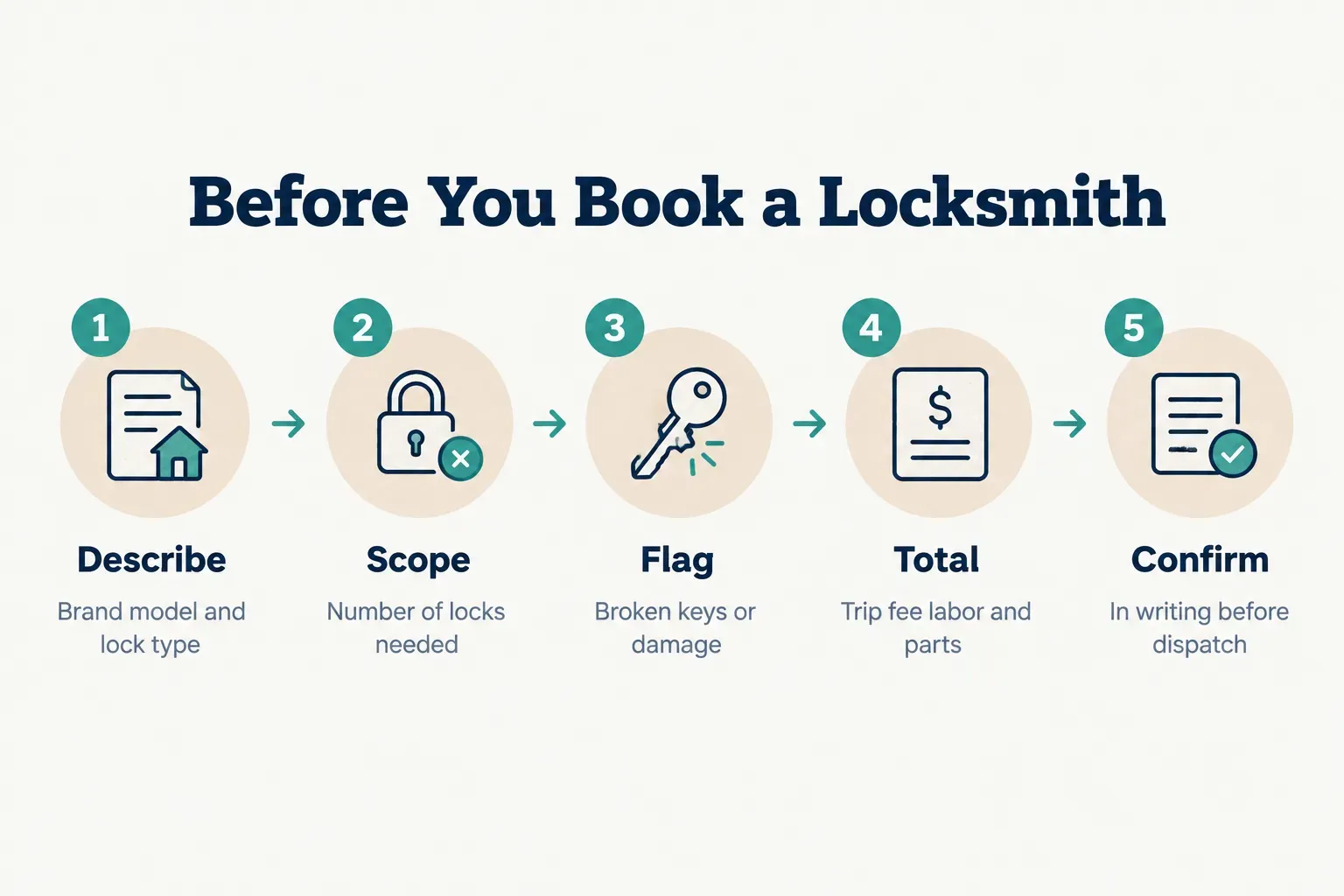
Give the dispatcher enough detail to price the job accurately, then ask for a firm total. Here’s a simple phone or chat script you can adapt:
- Describe the lock. “It’s a Kwikset deadbolt on a front door” or “It’s a 2021 Honda Civic with a push-button start.” Brand and model tell the locksmith which tools and parts to bring.
- Give the scope. State how many locks are involved and whether you want them rekeyed, replaced, or just opened.
- Flag complications. Mention if a key is broken off in the lock, the lock is damaged, or it’s a high-security brand like Medeco or Mul-T-Lock.
- Ask for the all-in number. “What’s the total price including the trip fee, labor, and parts?” Don’t accept a labor-only figure.
- Confirm surcharges and cancellation terms. Ask whether after-hours or mileage fees apply to your address, and what you’ll owe if you cancel after dispatch.
- Request it in writing. A text, email, or chat message counts as a written estimate and gives you something to point to if the price changes on arrival.
Red flags that signal overcharging
Scam operations often use generic names and lead-generation call centers that dispatch untrained subcontractors. Watch for these warning signs:
- A price that doubles on arrival. If the phone quote was $75 and the technician now says $250 “because it’s a high-security lock,” you’re likely looking at a classic bait-and-switch.
- A dispatcher who won’t give a company name. Answering with “Locksmith services” instead of a business name is a common sign of a lead-generation middleman.
- An out-of-area phone number. A “local” locksmith with a number from another state is probably routing your call through a national call center.
- Cash-only demands. Legitimate businesses accept cards, and cards give you chargeback protection if things go wrong.
- An unmarked vehicle. Established locksmiths usually drive branded vans and carry company ID.
- Immediate drilling. Most residential lockouts can be solved with non-destructive entry (picking, bypass tools, or shimming). A technician who reaches for the drill first may be creating a lock replacement sale.
Verifying licensing and identity
Locksmith regulation is a patchwork across the U.S. Some states, including California, Texas, Illinois, and New Jersey, require a state locksmith license; others leave it to city or county permits, and some have no licensing requirement at all.
That makes locksmith license verification your job.
Ask for the license number on the phone, then check it against your state’s licensing board website before the technician arrives. When they show up, confirm that the name on their ID matches the company you called.
Also ask for proof of insurance. A licensed, insured locksmith who damages your door frame or vehicle can cover the repair, while an uninsured one leaves you with the bill.
If you’d rather skip the phone roulette, a platform like Frendex lets you compare verified local locksmith profiles side by side, with upfront pricing and ratings that customers can only leave after a completed booking. You can chat with the locksmith to confirm the all-in quote, trip fee and parts included, before anyone is dispatched.
What to do before you dial
If you remember one thing from this guide, make it this: get the full price in writing or in chat before the technician is dispatched. That means the trip fee, labor, parts, and any after-hours or mileage charges, all added up into one number.
Then match your urgency to your budget. Here’s the short version:
Safety risk right now? Pay the emergency rate and don’t second-guess it.
A child locked in a car or a home left unsecured overnight is worth the extra $50 to $75.
No immediate danger? Schedule a daytime appointment and compare two or three transparent quotes first.
A few minutes of comparison can easily save $50 to $100, and it filters out the bait-and-switch operators who rely on panic.
Before you pay anything, also check whether your auto club, credit card, roadside plan, or landlord already covers the service.
The lowest advertised number isn’t the measure of a good locksmith. A transparent total that matches the final bill is.
So when you’re asking how much a locksmith costs, ask the better question too. Not “what’s your cheapest price?” but “what will I actually pay when you’re done?”
The locksmith who answers that clearly is usually the one worth hiring.
Frequently asked questions
How much does a locksmith cost to unlock a door?
A daytime house or apartment lockout typically costs $75 to $150 total, including the trip fee. Car lockouts run $75 to $200 depending on the vehicle. Expect to pay $25 to $75 more after hours.
How much does a locksmith charge to rekey a lock?
Rekeying a single lock costs $50 to $150, and rekeying a whole house with 4 to 6 locks usually runs $150 to $300. Rekeying is almost always cheaper than replacing hardware because you only pay for new pins, keys, and labor.
How much does it cost to change locks on a house?
Full lock replacement costs $150 to $400 per lock, including hardware and labor. The biggest variable is lock quality, since a Grade 1 deadbolt or smart lock costs significantly more than a basic builder-grade model. If your locks work fine, rekeying gives you the same security benefit for less.
Why are locksmiths so expensive?
Locksmith prices reflect skill, specialized tools, licensing, insurance, and round-the-clock availability, not just the minutes spent at your door. Transponder programming equipment alone can cost a locksmith thousands of dollars. A higher price often signals a trained, insured professional rather than overcharging.
How much does an emergency locksmith cost?
An emergency locksmith typically costs $125 to $250 for a lockout, since after-hours rates add a flat $25 to $75 or 1.5 times the standard hourly rate. Weekends and holidays usually carry the same surcharge. If there's no safety risk, waiting for daytime rates can save you meaningful money.
How do I know if a locksmith is legitimate?
A legitimate locksmith gives you a named business, a verifiable license number (where your state requires one), a marked vehicle, and a written estimate before work begins. Check the license against your state's licensing board and confirm the technician's ID matches the company you called. Refusal on any of these points is a reason to send them away.
Need a hand with something?
The Frendex map shows you who is available near you, in real time.
Get the app free Get the app freeFree, no card needed
Related articles
Furnace or boiler failure? Your emergency repair guide
Know in 5 minutes if it's a true emergency heating repair or a morning fix. Safety triage by system type, plus how to avoid scam callouts.
Pest control cost in 2026: What you'll really pay
Real 2026 pricing for one-time visits, recurring plans, and termite or bed bug jobs. Learn what drives $95 vs $1,400 quotes before you sign.
Boiler maintenance: A homeowner's safety and service guide
Learn which boiler checks are safe to DIY, which need a pro, and the warning signs that mean call for help now. A homeowner's framework for 2026.