Career coaching explained for every career stage
By Kiss János 13 min read

Why people seek career coaching now
Most people don’t hire a career coach because they’re lost.
They hire one because they have too many half-formed options and no reliable way to choose between them.
Career coaching is a structured, client-led process that helps you clarify your career goals, test your options, and make decisions you can stand behind.
It is not a service that hands you a job.
It doesn’t hand you a personality label that tells you who you are and what you should do for the next 30 years, either.
Demand has grown noticeably as of 2026. Career changers want a second act. Parents and carers are returning after extended leave. And professionals are watching their roles shift under them, through redundancy rounds or AI tools that absorb tasks that once filled half their week.
The World Economic Forum’s Future of Jobs Report 2025 estimated that 39% of workers’ core skills will change by 2030.
That’s a lot of people rethinking their next move at once.
This guide separates coaching from career counseling, mentoring, recruiting, and therapy, because those roles get confused constantly.
It walks through what a real engagement looks like, session by session.
Then it shows you how to evaluate a coach’s credentials and process before you book, so you spend your money on progress rather than pleasant conversation.
What a career coach does (and doesn’t)
Here’s the counterintuitive part: a good career coach gives you fewer answers than you expect.
That’s by design.
The core job of a career coach
Coaching is client-led.
The coach asks structured questions, helps you organize what you already know, and holds you to the commitments you make. They don’t diagnose what’s wrong with you or issue a list of recommended careers.
Think of a personal trainer who designs the program and counts the reps but can’t lift the weights for you.
In practice, that means a coach helps with career clarity, career decision-making, and building an action plan. Many also support job-search strategy, interview preparation, networking strategy, and personal branding.
The value is in the structure and the accountability, not in a coach “knowing” your ideal job.
Two things coaches generally don’t do.
Coaches do not place clients in jobs.
And most don’t write resumes as a core service, though some offer resume and LinkedIn development as a paid add-on.
Coaching vs counseling, mentoring and recruiting
These five roles overlap at the edges but differ sharply in focus, method, training, and who they ultimately work for. The table below lays out the distinctions.
| Role | Primary focus | Typical methods | Common credentials | Who pays / who they serve | Typical outcome |
|---|---|---|---|---|---|
| Career coach | Goals, decisions, and action on a forward-looking career question | Structured questioning, goal-setting, action experiments, accountability check-ins | ICF (ACC, PCC, MCC) or EMCC accreditation; niche or industry experience | Client pays; works for the client | Defined goal, tested options, completed action plan |
| Career counselor | Career exploration, often alongside personal or educational factors | Formal assessments, interpretation, guidance sessions | Graduate degree in counseling; often state or national licensure (e.g., LPC, NCC) | Client, school, or institution pays | Clearer direction, assessment-informed career planning |
| Mentor | Sharing experience from a similar path | Informal advice, introductions, storytelling | None required; seniority and track record | Usually unpaid; serves the mentee informally | Insider perspective, connections, career mentoring over time |
| Recruiter | Filling a specific open role | Sourcing, screening, matching candidates to briefs | None required; some hold industry certifications | Employer pays; works for the hiring company | A placement (if you fit the role) |
| Therapist | Mental health, emotional patterns, past experiences | Clinical assessment, evidence-based therapies such as CBT | Licensed clinician (psychologist, LCSW, LMFT, or equivalent) | Client or insurer pays | Improved wellbeing, symptom management |
The recruiter row deserves a second look.
Recruiters are paid by employers to fill roles, often as a percentage of the hire’s first-year salary. They can be genuinely helpful, but their incentive is the placement, not whether that job fits your long-term career development.
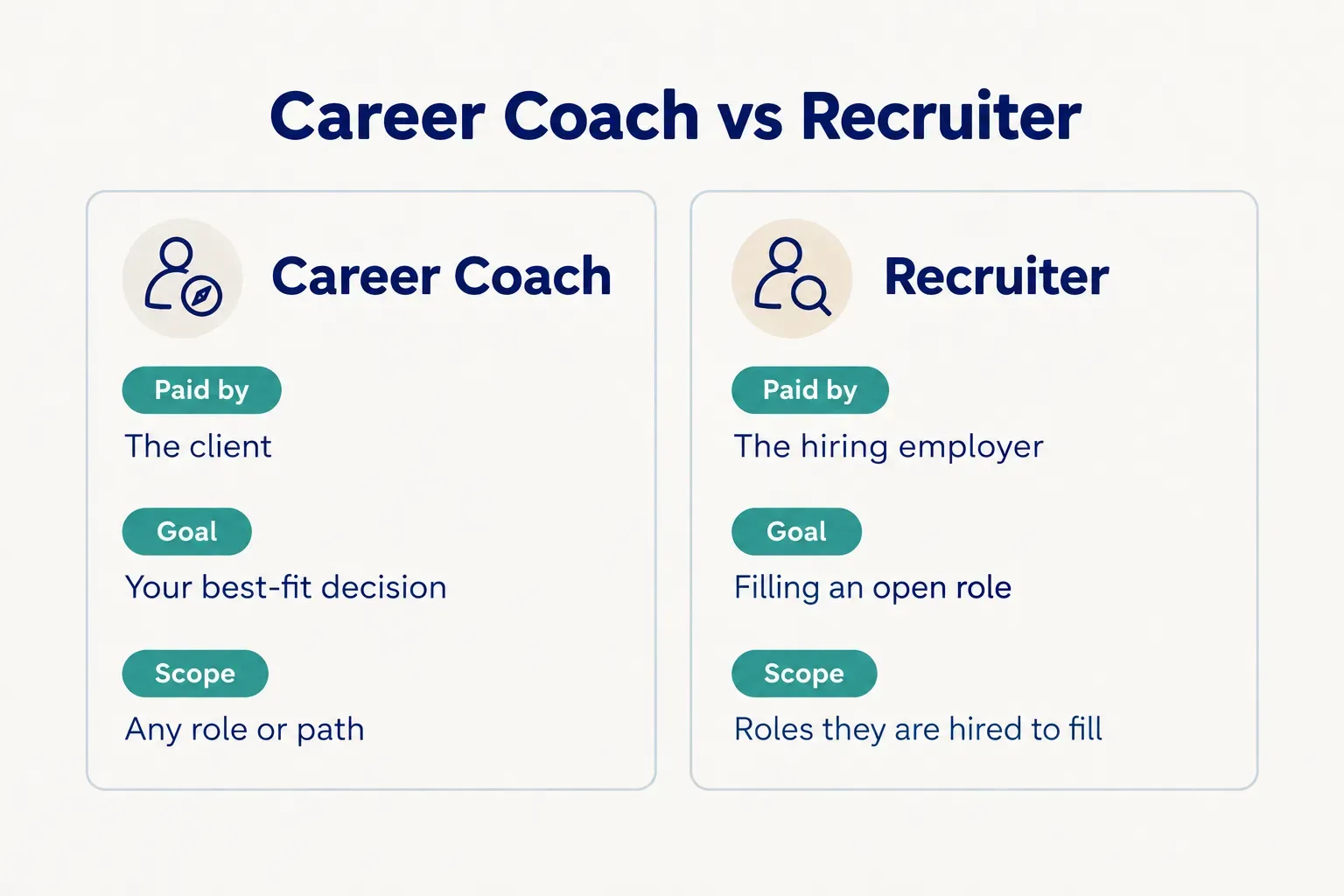
A coach, by contrast, has no stake in which job you take. Their success is measured by whether you reach the goal you set together.
How a coaching engagement unfolds
The best coaching engagements feel less like therapy sessions and more like a well-run project. There’s a brief, a plan, experiments, and reviews.
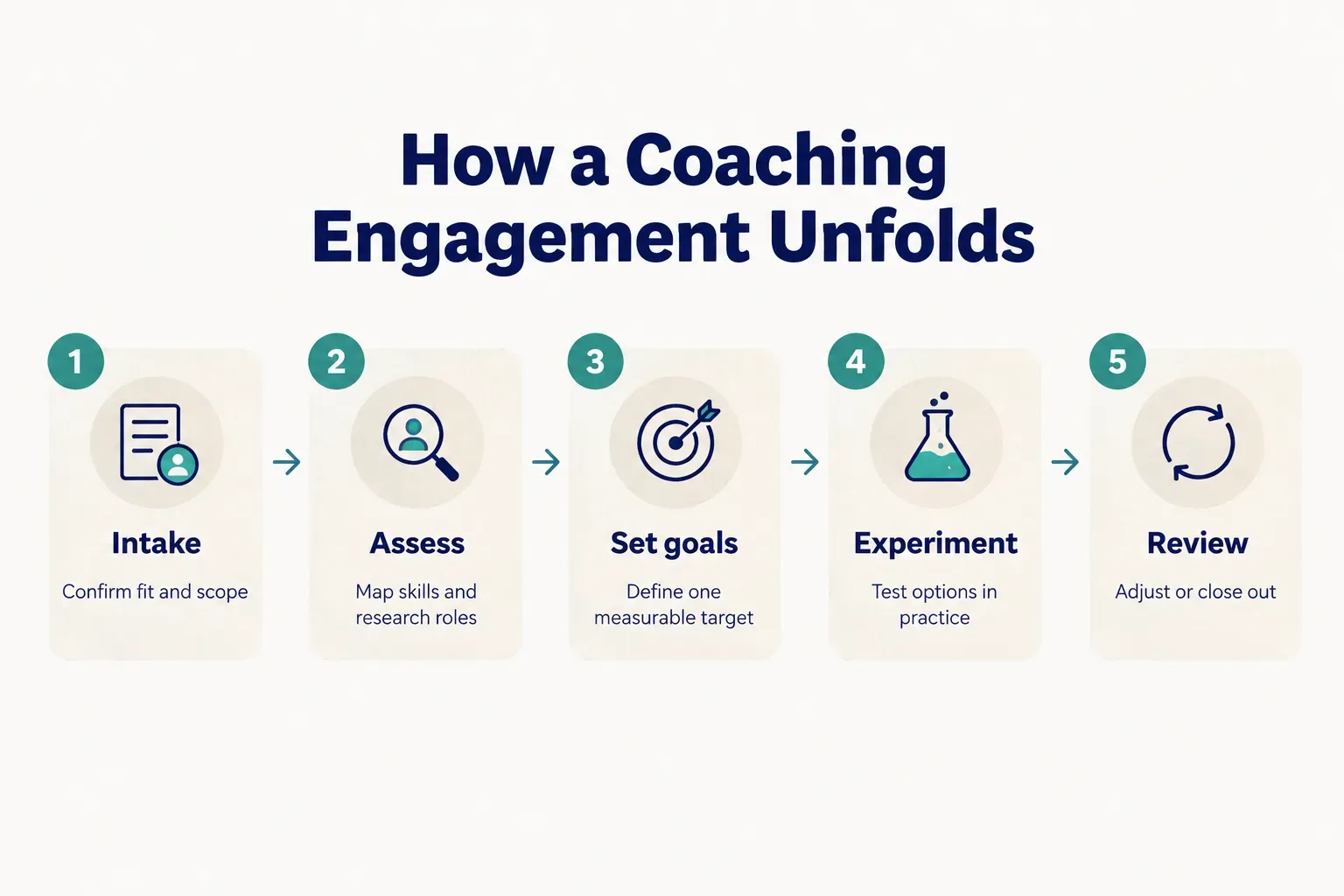
Most follow a recognizable sequence:
- Intake call. A short conversation (often 15 to 30 minutes, sometimes free) to confirm fit, understand your situation, and screen for anything that needs a different professional.
- Self-assessment and research. You map your interests and values, transferable skills, and constraints, then pair that with occupational research and labor market information on the roles you’re considering.
- Goal-setting session. You and the coach turn a vague ambition into a specific, measurable goal, typically framed as SMART goals.
- Action experiments. You test your assumptions in the real world through conversations, small projects, and targeted applications.
- Review. You assess what you learned, adjust the plan, and decide whether to continue, pivot, or close the engagement.
The first session
A first session that ends with “that was a great chat” has failed. It should produce concrete outputs you could write on an index card.
Specifically, a useful first session must produce:
- One defined goal. Not five. For example: “Decide between staying in finance and moving into product management by June.”
- Agreed scope. What the coaching covers and what it doesn’t, such as career transition planning but not resume writing.
- Measurable success indicators. Things like “six informational interviews completed” or “a ranked shortlist of two target roles.”
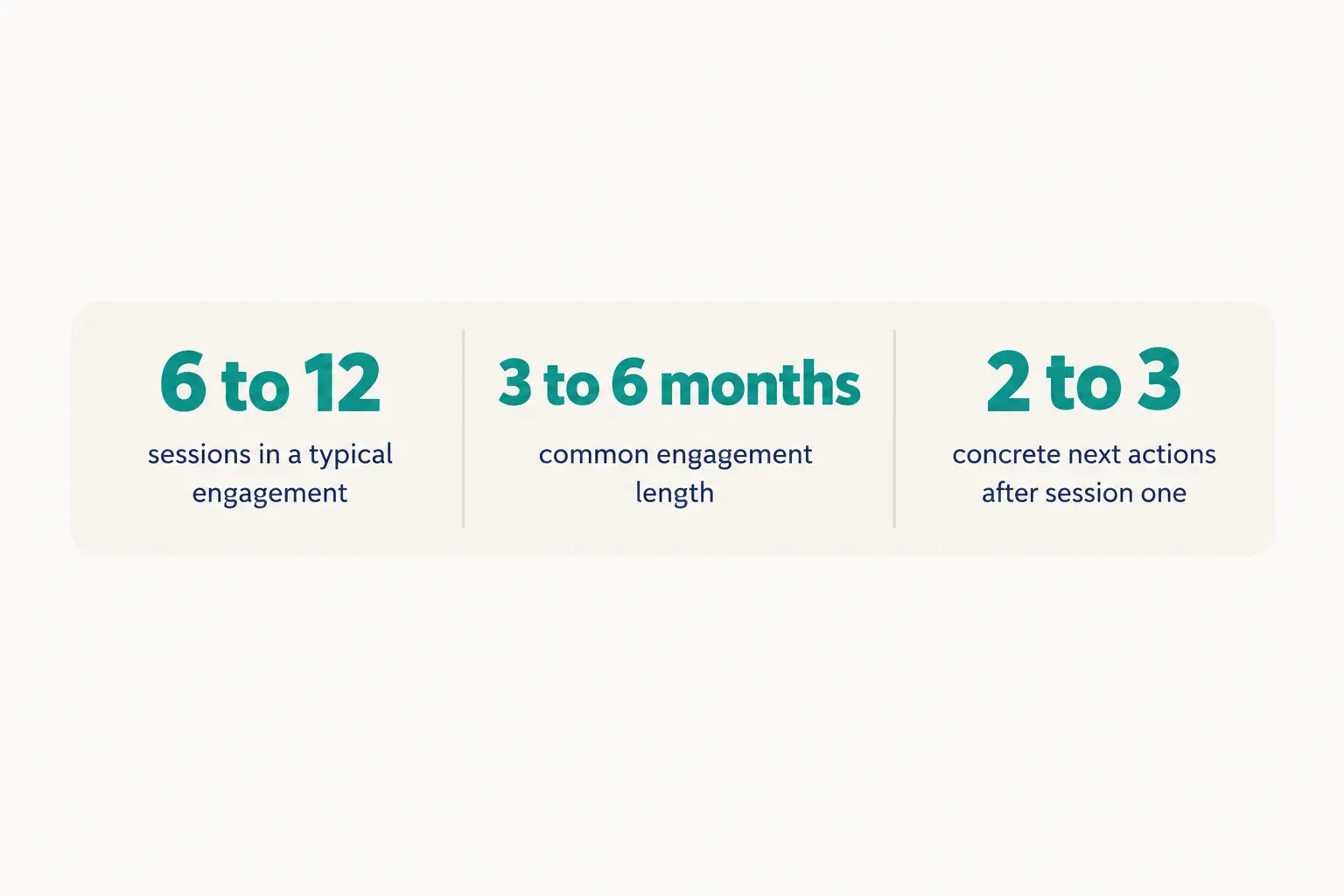
- Two to three concrete next actions. Small, dated, and doable before the next session.
If you walk away without these, ask for them. A competent coach will welcome the push.
Between sessions
Here’s where the real work happens.
Coaching sessions are the steering wheel; the time between them is the engine.
Typical between-session assignments include informational interviews with people already doing the job you’re considering.
You might complete a skills gap analysis, comparing your current abilities against ten real job postings to see which gaps actually matter. Some clients run application experiments, sending a small batch of tailored applications to test how the market responds to a new positioning.
Networking conversations count too, especially low-stakes ones with former colleagues.
The key habit is logging everything.
Bring notes on what surprised you, what energized you, and what killed an option outright. That record becomes raw material for the next session.
How long it typically takes
Most engagements run 6 to 12 sessions over 3 to 6 months. Sessions are commonly 45 to 60 minutes, spaced two to three weeks apart so there’s time to complete the between-session work.
The range depends heavily on the goal.
A single decision, such as whether to accept a promotion into management, might wrap up in four to six sessions. A full career change into a new industry, with retraining and repositioning, often needs the full six months and sometimes a few follow-up check-ins after.
Be wary of anyone promising a career transformation in two calls. Equally, be wary of open-ended packages with no review point.
Good coaches build in a checkpoint around session four to confirm you’re on track.
Who benefits from career coaching
Career coaching isn’t just for executives with corporate budgets.
The same structured process works at 19 and at 59.
What changes is the question you bring.
Coaching by career stage
Each stage comes with its own typical challenge. Here’s how coaching tends to help across distinct situations:
- Students choosing a path. Coaching helps translate interests and values into realistic options, then test them through internships, projects, and conversations rather than guesswork.
- Early-career professionals. The focus is often career planning for the first five years: which skills to build, when to move, and how to stop drifting into roles by default.
- New managers. Moving from doer to leader is one of the hardest professional development shifts. Coaching supports delegation, difficult conversations, and building credibility with a new team.
- Executives. Senior leaders use coaching for strategic career moves, board positioning, succession, and work-life integration at a level where few people will give them honest feedback.
- Career changers. Coaching structures the process of identifying transferable skills, closing gaps efficiently, and repositioning a resume and narrative for a new field.
- People returning after a break. Whether after parental leave, caregiving, or illness, returners benefit from rebuilding career confidence and explaining the gap without apology.
- Immigrants building a career locally. Coaching can help decode local hiring norms, credential recognition, and networking culture, which often differ sharply from a home country.
- Freelancers. Independent professionals use coaching for niche selection, pricing, personal branding, and deciding whether to stay independent or return to employment.
- People facing redundancy. A coach helps turn a shock into a plan, with a clear job-search strategy and a realistic timeline rather than panic applications.
Across these groups, coaches often use tools like the Strong Interest Inventory (built on Holland’s six RIASEC interest types) or CliftonStrengths, formerly StrengthsFinder, which ranks 34 talent themes.
These are useful inputs for reflection.
They are not a prescription for “the right career.”
A strengths assessment can tell you that you score high on “Strategic.”
It can’t tell you whether you’d enjoy consulting in Denver.
When you need something else instead
Sometimes the most valuable thing a coach can do is say, “I’m not the right person for this.” Certain situations call for a different professional:
- Persistent anxiety or depression. If low mood, panic, or burnout symptoms are driving the career question, a licensed therapist should come first or alongside coaching.
- Workplace discrimination or harassment. These are legal matters. An employment lawyer or relevant government agency can advise on rights and deadlines that a coach cannot.
- Disability accommodations. Specialized vocational rehabilitation services or disability employment advisers understand accommodation law and support programs in depth.
- Debt or major financial decisions. Taking a pay cut, cashing out a pension, or funding retraining with loans warrants a qualified financial adviser.
A good coach screens for these situations during the intake conversation. When they spot one, they refer out rather than overstepping their scope.
Treat a coach who confidently handles everything as a red flag, not a bargain.
Choosing a coach you can actually trust
Anyone can call themselves a career coach.
There’s no legal protection on the title in most countries, including the US and UK.
That makes your due diligence the main quality filter.
Credentials and experience to check
Start with professional accreditation.
The International Coaching Federation (ICF) offers three levels: ACC (at least 60 hours of training and 100 hours of coaching experience), PCC (125 hours of training and 500 hours of experience), and MCC (200 hours of training and 2,500 hours of experience).
The European Mentoring and Coaching Council (EMCC) runs a comparable accreditation framework from Foundation to Master Practitioner.
Certification proves training and ethics commitments.
It doesn’t prove fit.
So look further:
- Niche specialization. A coach who focuses on tech career changers or healthcare leaders will understand your field’s quirks faster than a generalist.
- Client population experience. Have they worked with returners, immigrants, new managers, or whichever group you belong to?
- Industry familiarity. They don’t need to have done your job, but they should understand how hiring works in your sector.
Then ask for examples of past work with similar clients. An anonymized case summary (“a mid-career teacher who moved into instructional design within five months”) tells you far more than a testimonial reading “life-changing!”
Questions worth asking first
A 15-minute discovery call is your best chance to spot a mismatch before money changes hands. Bring these questions:
- What coaching method do you use? Listen for a clear structure (for example, GROW model, solution-focused coaching, or a defined assessment-plus-experiments process) rather than “we’ll just see where it goes.”
- What’s your confidentiality policy? Especially important if your employer is paying or if you’re exploring a move your manager doesn’t know about.
- What are your cancellation and rescheduling terms? Know the notice period and whether missed sessions are forfeited.
- How is pricing structured? Per session, package, or retainer, and what’s included, such as email support or document reviews.
- What happens if goals aren’t met? A thoughtful answer covers mid-engagement reviews and honest conversations about whether to continue.
A coach’s answers to these five questions reveal more about their professionalism than any certificate on their website.
Evaluating coaches on an online marketplace
Hiring a stranger is easier when the platform does some of the vetting for you.
Not all marketplaces are equal, though.
The useful ones share a handful of trust features.
Transparent profiles show specializations, credentials, rates, and session formats upfront. Identity-verified badges confirm the person is who they claim to be.
Reviews matter most when they can only be left after a completed booking, which rules out friends-and-family padding.
In-app messaging lets you ask questions before committing, and visible calendar availability for online sessions saves the back-and-forth of scheduling.
Frendex is a concrete example of how this works in practice.
You’d start by searching the education and coaching category, then filter for remote availability if you want online sessions. Before booking, you can message a coach directly to ask your method, pricing, and confidentiality questions.
Then check for a Verified or Trusted badge, which coaches earn through completed sessions and identity checks rather than paid placement.
That last point matters more than it looks.
On platforms where coaches can pay for top ranking, the first result tells you who has the biggest marketing budget.
Badges earned through actual client work tell you who has delivered.
Your next concrete step
Want to get twice the value from your first session? Do ten minutes of homework before it.
Write down three things.
First, the decision or challenge you’re facing, in one or two sentences. Second, two real constraints, such as limited time, a minimum salary, or a location you can’t leave. Third, any evidence you’ve already gathered: saved job postings, notes from an informational interview, feedback from a past performance review.
Coaching works best when you arrive with raw material, not a blank page.
A coach can sharpen a messy draft in an hour.
Starting from nothing burns two sessions just finding the question.
And keep perspective.
The right coach is a structured accelerant for your career goals… not a replacement for your own research, your own conversations, or your own decisions.
You do the work.
They make sure it adds up to something.
Frequently asked questions
What exactly does a career coach do?
A career coach helps you define a career goal, test your options, and follow through on an action plan through structured questioning and accountability. They guide the process while you make the decisions. Many also support interview preparation, networking strategy, and job-search strategy, but they don't place you in jobs.
Is career coaching worth it?
Career coaching is worth it when it produces measurable progress, not just good conversations. Track indicators such as clarified target roles, completed experiments, networking conversations held, applications sent, and your interview conversion rate. Decision confidence counts too: if you can explain your choice and the evidence behind it, the investment has paid off.
What is the difference between a career coach and a career counselor?
A career counselor is usually a licensed professional with graduate training in counseling, while a career coach focuses on forward-looking goals and action. Counselors often interpret formal assessments and can address personal or emotional factors affecting career choices. Coaches concentrate on decisions, experiments, and accountability toward a defined goal.
How do I find the right career coach?
Find the right career coach by matching their credentials and niche experience to your specific situation. Check for ICF or EMCC accreditation, ask for examples of work with similar clients, and hold a short discovery call before booking. On online marketplaces, favor coaches with verified identities and reviews from completed sessions.
What questions should I ask a career coach?
Ask about their coaching method, confidentiality policy, cancellation terms, pricing structure, and what happens if goals aren't met. Also ask how many clients they've coached in your situation. Clear, specific answers signal a professional process.
Can a career coach help me change careers?
Yes, a career coach can help you change careers by structuring the transition into testable steps. They help you identify transferable skills, research target roles, run a skills gap analysis, and reposition your narrative. Full career changes typically take 3 to 6 months of coaching alongside your own research and networking.
Need a hand with something?
The Frendex map shows you who is available near you, in real time.
Get the app free Get the app freeFree, no card needed
Related articles

Finding an Excel tutor who gets results
Finding an Excel tutor who gets results Do you actually need an Excel tutor?

How much does a locksmith cost in 2026?
See what locksmiths actually charge in 2026, trip fees, labor, and parts included. Real job costs and hidden add-ons before you book a call.

What your bumper repair shop isn't telling you
A $200 scratch can hide $2,000 in hidden damage. See what's behind the plastic, what drives repair costs, and how to vet a shop before you pay.